
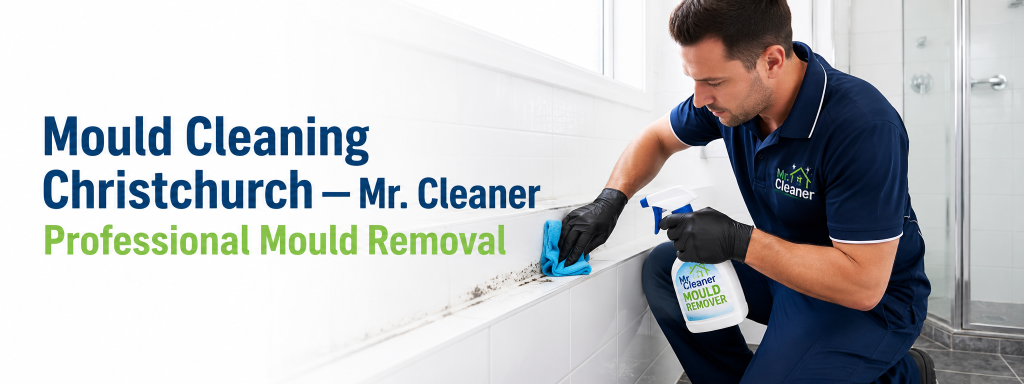
Mould is one of the most common issues affecting Christchurch homes, but simply wiping away visible mould often does not solve the real problem. While DIY sprays may remove surface marks temporarily, the moisture source behind mould growth can continue causing it to return. Professional mould cleaning Christchurch services from Mr. Cleaner focus on identifying the cause, treating affected areas properly, and helping prevent future mould problems. If mould keeps appearing in your home, this guide explains why it happens and how professional cleaning provides a more effective long-term solution.
Why Christchurch Homes Get Mould More Than Most New Zealand Cities?
Canterbury winters are cold and long. From May through August most Christchurch homes run central heating continuously, but heat pumps that warm the air don’t warm the surfaces — windows, exterior walls, and bathroom tiles stay cold even when the room feels warm. Warm air carrying moisture from cooking, showering, and breathing contacts those cold surfaces and condenses. That condensation sitting on silicon seals, grout, plasterboard, or painted walls creates exactly the conditions mould needs to grow. Mr. Cleaner’s team cleans Christchurch homes every day and the same mould problems appear in the same locations across every suburb — because the climate creates them consistently regardless of how carefully residents clean.
A significant proportion of Christchurch homes are older villas and bungalows built before current insulation standards. Many have single-glazed windows, inadequate wall insulation, and limited bathroom ventilation. These homes are consistently colder on interior surfaces during winter, which means condensation forms more readily and stays longer. Post-earthquake homes across the eastern suburbs also carry specific mould risks — repairs that sealed walls and ceilings without adequate vapour barriers can feed mould growth for months before it becomes visible.
Where Mould Cleaning Christchurch Services Help Most in Your Home?
Bathroom silicon seals and grout
The most common location in every Christchurch home we clean. Bathrooms generate consistent moisture and without adequate ventilation that moisture has nowhere to go. Silicon seals are the most frequently failed mould item at Christchurch property inspections — not because tenants haven’t tried to clean them, but because mould grows into silicon rather than sitting on the surface. Once it has penetrated the seal, spray treatment removes the colour and leaves the spores. They regrow within four to six weeks. The correct treatment is to cut out the affected seal, clean and dry the area properly, and apply fresh silicon. Mr. Cleaner handles this as part of our mould cleaning service — if the seal needs replacing we tell you, and we treat the surrounding tiles and grout with appropriate product and dwell time to prevent immediate reinfection.
Bathroom and laundry ceilings
Hot moisture from showers rises and condenses on the ceiling. Without an effective extractor fan the ceiling stays wet for extended periods after every shower. Mould on bathroom ceilings is almost always a ventilation problem. Mr. Cleaner treats bathroom ceilings with mould-specific products applied at the correct concentration and left for adequate dwell time — not a spray-and-wipe across the surface. We also tell you directly if the extractor fan is not drawing air properly, because treating the ceiling without fixing the ventilation produces the same result again within one season.
Window reveals and tracks
Windows are the coldest surfaces in most Christchurch rooms during winter. Condensation forms on the glass and runs down into the frame and the painted wall surface beside it. Mould in window tracks and reveals is consistent across Christchurch’s older housing stock. Our residential cleaning service cleans window tracks and reveals as standard, and our mould treatment service applies appropriate product to affected painted surfaces with the correct method to prevent damage to the paint finish.
Exterior walls — interior surface
Mould behind furniture and in wall corners indicates cold bridging through inadequately insulated walls. By the time you see it, it has typically spread significantly on the wall surface behind the visible growth. Mr. Cleaner treats wall surface mould carefully — the products and methods used on a tiled bathroom surface are different from those appropriate for painted plasterboard, and using the wrong approach damages the paint or spreads moisture into the wall. We identify the extent of the growth, use appropriate treatment, and advise whether the affected area indicates a building insulation issue that will cause regrowth regardless of how thoroughly the surface is cleaned.
Washing machine door seals
The rubber gasket on front-loading washing machines stays damp after every wash cycle. In Christchurch laundries that are poorly ventilated through winter, black mould in this seal is almost universal. It is also one of the most commonly failed items at rental property final inspections. Mr. Cleaner treats washing machine seals as part of every bond clean and deep clean service — the seal is cleaned with appropriate product, the drum interior is wiped, and we advise if the seal is at the point where mould has penetrated the rubber and replacement is needed rather than cleaning.
Damp carpets and trapped moisture can also contribute to indoor mould problems. Professional carpet cleaning Christchurch helps remove deep-set dirt, allergens, and moisture-related buildup.
DIY Mould Treatment — When It Works and When It Doesn't
Surface mould in early stages on non-porous materials can be treated effectively at home. Understanding the difference between what can be cleaned and what needs to be replaced determines whether your effort produces a lasting result.
Mould remover products containing sodium hypochlorite work on tiles, glass, and chrome — but only if you allow adequate dwell time. Most people spray and wipe immediately. The product needs ten to fifteen minutes of contact time before wiping to actually kill spores rather than just bleach the colour. Spray, leave it for fifteen minutes, come back, then wipe. Repeat on persistent areas.
Silicon seals with visible black mould that has been present for more than a few weeks cannot be successfully cleaned with spray treatment. The mould has grown into the material. Cleaning removes the colour but not the organism. This is why spray-treated seals go black again within weeks — the spores were never eliminated. The seal needs to be cut out and replaced. This is what Mr. Cleaner does when we assess a bathroom with persistent seal mould.
Mould on painted walls or ceilings that reappears after cleaning within one season indicates the moisture source has not been addressed. Treating the surface again without fixing the ventilation, insulation, or leak that is feeding the moisture is a temporary fix. When our team identifies recurring wall mould we identify the moisture source first and advise on both the cleaning treatment and the building or ventilation change needed to prevent recurrence.
When mould coverage is larger than one square metre or when it is on porous materials including plasterboard, timber framing, or insulation — professional mould cleaning is the correct approach rather than DIY treatment. Disturbing large mould areas without proper containment spreads spores through the house and can worsen indoor air quality significantly. Mr. Cleaner handles these jobs with appropriate protective equipment and containment.
What Our Professional Mould Cleaning Service Includes
When Mr. Cleaner carries out mould cleaning in a Christchurch home the process is different from wiping surfaces with spray. Our service includes the following.
Professional Mould Cleaning Christchurch Assessment Before Treatment
We identify where the mould is, how extensive it is, and what is causing the moisture that feeds it. This determines whether cleaning alone solves the problem or whether we need to advise on building maintenance or ventilation changes alongside the treatment.
Correct product selection for each surface
The treatment appropriate for a tiled bathroom surface is different from what should go on a painted wall or a rubber seal. Using the wrong product damages surfaces and does not eliminate mould effectively. Our team knows what to use on every surface type found in Christchurch homes.
Proper dwell time on every treated area
Professional mould treatment is not a spray-and-wipe service. Products are applied, left for the time needed to work, and then removed correctly. This is the step most DIY attempts skip and it is the difference between killing spores and bleaching them.
Silicon seal assessment and replacement where needed
We tell you honestly when a seal needs replacing rather than cleaning and we handle the removal, cleaning, drying, and re-sealing as part of the mould service.
Extractor fan and ventilation assessment
If your bathroom extractor fan is not drawing adequately, treating the ceiling mould will produce the same result again within months. We check the fan during every bathroom mould job and advise if the duct is blocked, kinked, or the fan unit itself needs replacing.
Full bathroom and laundry treatment in a single visit
Bathroom ceiling, silicon seals, grout, tiles, extractor fan cover, washing machine seal, and window tracks are all covered in one booking rather than requiring multiple visits.
Advice on what will cause regrowth
We explain what is a cleaning issue versus what is a building or ventilation issue, what you can do between professional treatments to slow accumulation, and when the mould you’re dealing with is beyond surface treatment and requires a different approach.
Mould at Rental Property Inspections — What Mr. Cleaner Covers
Mould at a Christchurch rental property inspection is one of the most common and most disputed causes of bond deductions. Understanding what is a tenant responsibility and what is a landlord responsibility matters — and so does knowing what professional cleaning can resolve versus what requires maintenance or repairs.
Silicon seals that are black with mould penetration need to be replaced, not cleaned. If those seals were in good condition when the tenancy began and have deteriorated during the tenancy, the cost of replacement is typically a tenant responsibility. Mr. Cleaner’s bond cleaning service assesses seals honestly — if replacement is needed we tell you before the inspection rather than after. We can arrange the seal replacement as part of the same booking.
Mould on bathroom ceilings and walls caused by an inadequate extractor fan is a landlord maintenance responsibility under New Zealand’s Healthy Homes Standards. If our team identifies that mould has been caused by a non-functioning or inadequate extractor fan we document this for you so you have the information needed to raise it with your property manager or lodge a Tenancy Tribunal application if needed.
Mould on surfaces that were being adequately ventilated and maintained is a cleaning issue that Mr. Cleaner’s bond cleaning service covers completely as part of our standard service. If anything is flagged at inspection after our clean we return within 24 hours at no charge to address it. For tenants preparing for final inspections, following a proper move out cleaning checklist Christchurch can help ensure important areas are not missed.
Mould Prevention — What Actually Works in Christchurch
The most effective mould prevention in a Christchurch home addresses the moisture source rather than the mould itself. Mr. Cleaner advises every client on the following after mould treatment.
Run the extractor fan for thirty minutes after every shower
Moisture that builds up on tiles and walls during a shower continues evaporating for twenty to thirty minutes after the water stops. Running the fan only during the shower removes a fraction of the total moisture load. A fan with a timer makes this automatic.
Check that the extractor fan duct is actually working
Many Christchurch homes have fans that run but don’t extract — the duct is blocked, kinked, or disconnected in the ceiling space. Hold a tissue near the fan grill when running. If it doesn’t hold in place the duct needs to be inspected. Mr. Cleaner identifies this during every bathroom mould service.
Wipe window condensation each morning in winter
Taking two minutes each morning to wipe down condensation before it runs into the frame and track prevents the persistent moisture that feeds window and frame mould. A window squeegee or microfibre cloth kept in the bathroom makes this a quick habit.
Avoid drying laundry indoors in an unventilated room
A standard load of wet laundry releases approximately two litres of water into the room air as it dries. In a poorly ventilated Christchurch home in winter that moisture ends up on cold surfaces. If indoor drying is unavoidable keep a window open and the extractor fan running while the laundry dries.
Poor ventilation and hidden moisture are also common reasons cleaning problems return. Learn more about why dust keeps coming back after cleaning and how to reduce indoor buildup.
Book Professional Mould Cleaning in Christchurch
Mr. Cleaner provides professional mould cleaning, bathroom deep cleaning, and full property mould treatment across all Christchurch suburbs. Locally owned, fully insured, 4.7-star rated from 88+ verified Christchurch reviews. Not a franchise — one team, one standard, and direct accountability for every booking. Whether you need mould treated before a rental inspection, a full property deep clean that includes comprehensive mould treatment, or an honest assessment of what is a cleaning issue versus a building maintenance issue, contact Mr. Cleaner for a free no-obligation quote.
📍 Christchurch, New Zealand
📞 022 107 3435 | 022 019 5919
🌐 mistercleaner.co.nz/contact-us
We cover Fendalton, Merivale, Riccarton, St Albans, Papanui, Shirley, New Brighton, Halswell, Cashmere, Hornby, Wigram, Addington, Burnside, Ilam, Avonhead, Parklands, Sumner, Linwood, Spreydon, Belfast, Northwood, and everywhere in between.