
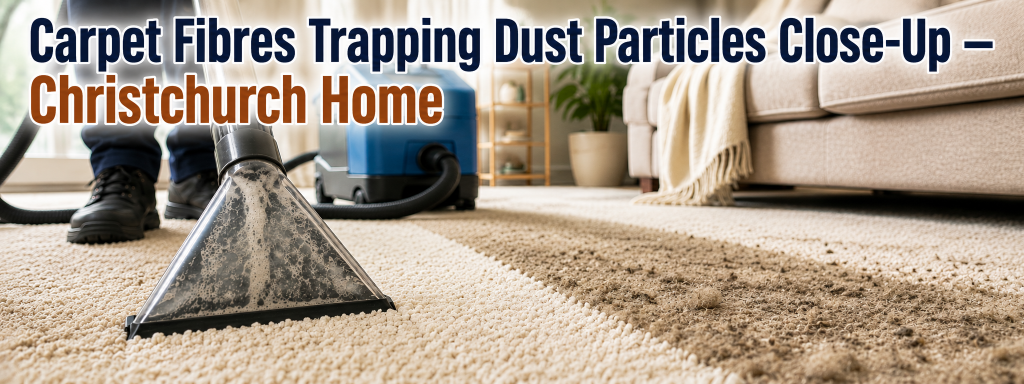
If your home constantly feels dusty no matter how often you vacuum, the problem often starts right under your feet. Many homeowners don’t realise that carpets do far more than simply collect visible dirt. They act like a large filter system, trapping dust, pollen, pet dander, and fine particles deep within the fibres before releasing some of them back into the air over time. Upholstered furniture works in a very similar way. This is why carpet cleaning Christchurch services play an important role in maintaining cleaner indoor air and reducing hidden dust build-up inside homes. Together, carpets and upholstery contribute significantly to the dust cycle in Christchurch homes — and understanding how this process works can help you manage it more effectively.
Why Carpet Is Different From Hard Floors?
When dust settles on a hard floor, it sits on the surface. Vacuum it, mop it, and it’s gone — clean to the substrate.
Carpet is entirely different. Carpet fibres have three dimensions. Dust particles don’t just settle on top — they filter down through the pile until they reach the backing layer. In a dense carpet pile, particles can migrate several millimetres below the surface.
A vacuum cleaner with standard suction picks up material from the top portion of the pile. The deeply embedded material — which can represent months or years of accumulation — largely stays put.
Here’s what makes this more than a theoretical concern: every time someone walks across that carpet, the compression and release of the fibres pumps deeply embedded material back up toward the surface, where it re-enters the air. Your carpet isn’t just storing dust. It’s continuously cycling it.
The Specific Types of Material Carpet Holds
It’s worth knowing what “dust” in a carpet actually consists of, because it changes how you think about the problem:
Fine soil and mineral particles tracked in from outside
Textile fibres shed from the carpet itself and from clothing
Skin cells shed by occupants and pets
Pet dander (even in homes without pets, if previous occupants had them)
Pollen — particularly relevant in Canterbury’s high-pollen seasons
Mould spores if any moisture has been present
Dust mite waste particles — one of the most common indoor allergens
The last item deserves emphasis. Dust mites don’t just live on mattresses. They’re found throughout any home with carpet and soft furnishings, and their waste particles are a significant contributor to dust-related respiratory symptoms. Professional hot water extraction cleaning eliminates a high proportion of this material in ways that surface vacuuming cannot.
Upholstery Traps Dust the Same Way — But Gets Cleaned Far Less Often
Most homeowners vacuum their carpets at least weekly. Almost none of them vacuum their sofa with the same regularity.
Yet the upholstery on a sofa functions similarly to carpet. Woven or knitted fabric fibres create a three-dimensional matrix that traps particles. Daily use — sitting, leaning, pets jumping on furniture — drives material deeper into the fabric. And every time someone uses the sofa, some of that material is agitated back into the air.
A sofa that’s used for four or five hours daily by two or three people is accumulating material at a meaningful rate. After a year or two without upholstery cleaning, the total particle load can be substantial.
The same logic applies to armchairs, ottomans, fabric dining chairs, and any cushions without removable washable covers.
How Carpets and Upholstery Work Together to Sustain Your Dust Problem?
What Regular Vacuuming Does (And Doesn't Do)?
Regular vacuuming is absolutely worth doing — but it’s important to understand its limitations so your expectations are calibrated correctly.
What it does:
- Removes surface-level loose particles
- Prevents fresh material from migrating deeper
- Reduces the total particle load in upper carpet fibres
What it doesn’t do:
- Extract deeply embedded material from the base of the pile
- Remove dust mite waste that’s bonded to fibres
- Clean upholstery adequately without an upholstery attachment used correctly
- Address material that’s migrated into the carpet backing
Vacuuming maintenance is like maintaining a reservoir at a lower level — it doesn’t empty it. Professional hot water extraction cleaning (often called steam cleaning) is what actually extracts the deep-seated material.
Why Carpet Cleaning Christchurch Matters for Healthier Homes?
In Christchurch specifically, there are a few reasons why professional carpet cleaning matters more than in some other locations:
Fine Canterbury soil. The mineral-rich, fine-grained soil from the Plains and Port Hills areas tracks into homes easily and penetrates carpet pile deeply. It’s abrasive to fibres over time and difficult to extract with standard vacuuming.
Pollen seasons. Christchurch has significant grass and tree pollen seasons. Carpet acts as a sink for pollen particles, which can affect family members with allergies long after the pollen season has passed if carpets aren’t professionally cleaned.
Older housing stock. Many Christchurch homes have carpet that was installed pre-earthquake or has been in place for many years. Older carpet has accumulated material over a long period and may have a baseline load that no maintenance routine can adequately address without a professional reset.
Our carpet cleaning service uses hot water extraction to reach deep into carpet pile — the same method recommended by most carpet manufacturers for periodic cleaning. It’s not about aesthetics alone; it’s about removing what your vacuum leaves behind.
How Often Should You Schedule Carpet Cleaning Christchurch Services?
As a practical guide for Christchurch homes:
Carpet
Every 12 months for average households; every 6 months for homes with pets, young children, or allergy sufferers.
Upholstery
Every 12–18 months for regularly used furniture; sooner if there are pets or if cushion covers aren’t removable and washable.
Rugs
At least annually, and immediately after any spill or pet accident that penetrates past the surface.
You can also read why your living room collects dust fastest to understand how furniture and airflow contribute to dust build-up.
Common Mistakes People Make With Carpet and Upholstery Cleaning
Waiting until it looks dirty. By the time carpet looks visibly soiled, the particle load is already high. Smell, not just appearance, is a better indicator of when cleaning is overdue.
Using too much water when spot-cleaning. Over-wetting carpet encourages mould growth in the backing layer — which then adds mould spores to your dust mix. Always blot rather than soak, and ensure thorough drying.
Assuming ‘dry’ carpet cleaning methods are equivalent. Some dry cleaning methods are useful for maintenance, but hot water extraction is the benchmark for deep cleaning. If a provider tells you otherwise, ask for specifics.
Ignoring the mattress. Your mattress has more in common with your carpet than with your sofa — it has a large surface area, significant depth, accumulates skin cells and dust mite material continuously, and is almost never professionally cleaned. It’s worth treating at the same frequency as your upholstered furniture.
After Professional Cleaning: Making It Last
Once carpets and upholstery have been professionally cleaned, maintaining that standard is much more achievable than getting there from a high-accumulation starting point.
Practical habits that help:
- Vacuum carpets twice weekly in high-traffic areas
- Use an upholstery attachment on sofas at least weekly
- Wash removable cushion covers monthly
- Use doormats and a no-shoes policy to reduce soil ingress
- Address spills promptly and correctly
These habits keep the reservoir from refilling quickly. Combined with a periodic professional clean, they’re the most effective dust management approach for carpet-heavy Christchurch homes. Pairing carpet maintenance with a regular residential cleaning service helps keep dust levels lower throughout the home.
Conclusion
Carpet and upholstery aren’t just surfaces that get dusty. They’re complex systems that accumulate, hold, and release particles in ways that significantly shape indoor air quality and dust levels throughout your home.
Understanding how they work — and addressing both with the right combination of regular maintenance and periodic professional cleaning — is the most direct way to reduce dust in most Christchurch homes.
Thinking about getting your carpets professionally cleaned? Mr. Cleaner provides carpet and upholstery cleaning across Christchurch, using hot water extraction to reach what vacuuming leaves behind. Get a free quote and find out what a difference it makes. If your home still feels dusty after cleaning, read why dust keeps returning after cleaning to understand the hidden causes.