
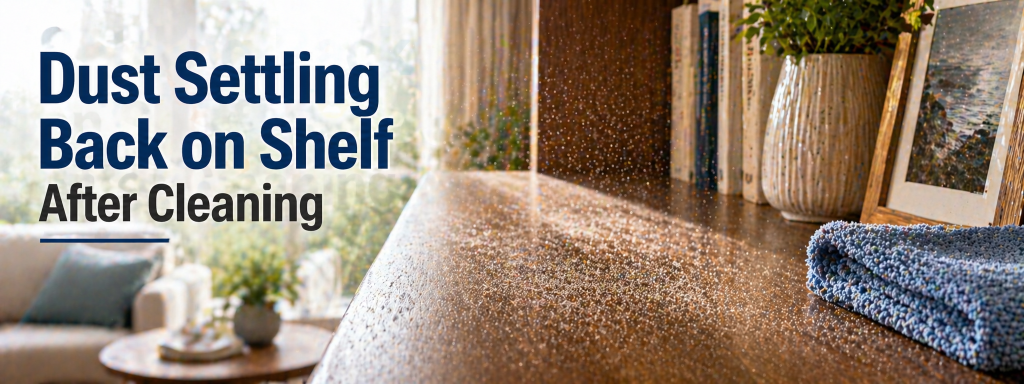
You dust the shelves on Saturday. By Tuesday, there’s a fine grey film back on everything. Sound familiar?
If it feels like dust keeps coming back after cleaning, you’re not doing anything wrong. The issue is often deeper than just surface cleaning. Small factors in your home are quietly feeding the problem — and no amount of weekly dusting will fix it unless those root causes are addressed.
Here’s why dust keeps returning, explained honestly.
Why Dust Keeps Coming Back After Cleaning?
Most people think of dusting as removal. You wipe the shelf, the dust is gone. Job done.
But here’s the thing — dusting often just relocates dust rather than eliminating it. When you wipe a surface with a dry cloth, a significant portion of that dust becomes airborne. It floats around for minutes, sometimes hours, then settles right back down on the very surfaces you just cleaned.
That’s not a cleaning failure. That’s physics.
Until you deal with the sources of dust and the airflow patterns in your home, you’re essentially rearranging the same particles over and over. Many of these issues come from hidden sources of dust in your home
You're Likely Cleaning in the Wrong Order
This is one of the most common mistakes homeowners make, and it’s brutally simple to fix.
If you vacuum the floors before you dust the shelves, you’re doing it backwards. Dust from high surfaces falls down during cleaning — onto your freshly vacuumed floor. Now you need to vacuum again.
The correct order:
- Dust top surfaces first (ceiling fans, tops of shelves, light fittings)
- Work downward to benches, furniture, skirting boards
- Vacuum or mop floors last
This one change can cut your re-accumulation time significantly.
Why Dry Dusting Makes Dust Come Back After Cleaning?
Dry microfibre cloths are better than nothing, but they’re not the best tool for the job. On smooth surfaces, a slightly damp microfibre cloth is far more effective — it traps particles instead of launching them back into the air.
For electronics and screens where moisture isn’t ideal, use an electrostatic duster that clings to particles electrostatically. They’re cheap and genuinely outperform standard feather dusters.
What you want to avoid entirely: the old-fashioned feather duster. It’s essentially a dust redistribution device.
Your Vacuum Filter May Be the Problem
Here’s something most people never check: a clogged or low-quality vacuum filter can blow fine dust particles back into the room through the exhaust.
If your vacuum doesn’t have a HEPA filter, it may be capturing large dust bunnies while expelling microscopic particles that are actually more problematic for air quality. In Christchurch homes where pollen, soil dust, and building particulates are common, this matters.
Check your vacuum filter. If it’s over 12 months old or visibly grey, replace it. If your machine doesn’t support HEPA filtration, it may be time for an upgrade — or a professional deep clean to reset the baseline.
Soft Furnishings Are Continuously Releasing Dust
Your sofa, curtains, rugs, and bedding are not passive objects. Every time someone sits down, walks past, or opens a window, these surfaces release a cloud of fine fibres and trapped particles.
This is why dust returns even if you clean hard surfaces regularly. The soft surfaces in your home act as a reservoir — constantly feeding new particles into the air circulation.
Vacuuming soft furniture weekly (not just floors) and washing curtains and cushion covers every few months makes a measurable difference. If you have carpet throughout, professional cleaning twice a year helps remove what surface vacuuming cannot reach. Regular carpet cleaning helps remove deep dust that standard vacuuming cannot reach.
Air Movement Is Redistributing Dust Constantly
Heating systems, ceiling fans, open windows, and even people walking through rooms create airflow. That airflow picks up settled dust and redeposits it elsewhere in the house.
In Christchurch, the nor’wester wind is particularly relevant. On nor’wester days, homes that have windows open experience a significant influx of fine soil and pollen particles from the Canterbury Plains. What feels like a fresh breeze is actually a dust delivery service.
Being strategic about when you open windows — avoiding high-wind days or at least using flyscreens — can noticeably slow down dust accumulation.
Humidity Plays a Bigger Role Than You Think
Dust doesn’t just float and settle at random. In very dry air, dust particles stay airborne longer and travel further before settling. In more humid conditions, particles tend to clump and drop faster — which sounds worse, but actually means they’re easier to capture in one place.
Christchurch winters are notoriously dry indoors due to central heating. A quality humidifier set to around 40–50% relative humidity can reduce how far dust travels, making your cleaning efforts more effective.
When Cleaning Alone Isn't Enough?
If your home has never had a professional deep clean, there’s likely a reservoir of dust embedded in carpets, upholstery, skirting boards, and ceiling corners that regular cleaning never reaches. This becomes a continuous slow-release source.
A professional residential clean — particularly one that includes carpet cleaning and full surface treatment — resets that baseline. After that reset, your regular maintenance cleaning becomes far more effective.
At Mr. Cleaner, we serve homes across Christchurch from Fendalton to New Brighton. A professional residential clean isn’t a luxury — for heavily dusty homes, it’s often the only way to break the cycle.
Quick Summary: Why Dust Keeps Coming Back
- You’re cleaning in the wrong order
- Dry dusting redistributes rather than removes
- Your vacuum filter isn’t trapping fine particles
- Soft furnishings are continuously releasing dust
- Air movement keeps redistributing settled dust
- Dry indoor air keeps particles airborne longer
Fix one of these, and you’ll notice a difference. Fix all of them, and you’ll finally feel like your cleaning actually lasts.
Final Verdict
Dust returning quickly isn’t a sign that you need to clean more often — it’s a sign that something in the cleaning process or the home environment needs to change. Start with the order you clean, upgrade your tools, and address the hidden reservoirs. The difference is real and noticeable.
Ready for a clean slate?
If dust in your Christchurch home feels genuinely unmanageable, our team can help reset the baseline with a thorough residential cleaning service tailored to your home’s specific needs. No obligation — just a cleaner starting point.